Wednesday, February 24, 2010

nicholas's other love

Nicholas and his father, Alexander III, were unique men for their times - they were both faithful to their wives. Perhaps Alexander was motivated by the scandalous relationships his father, Alexander II, had, including of course the kicker, Princess Yurievskaya. And while Nicholas was faithful after he married Alexandra, there was one other woman who could claim his heart, however naively it was given: the ballerina Mathilde Kschessinska.

Nicholas's affair with Mathilde started in 1890 and lasted three years. If it was widely accepted for men to have mistresses, it was almost expected that these mistresses would be dancers. Nicholas had already met Alexandra, then Alix, by this point and did not disguise his love for her from Mathilde. She was grateful for his attention and happy to remain in her position. "I adored the tsarevich and wanted only one thing...my happiness, however brief it might be," she later wrote.

They later parted ways amicably when Nicholas married Alexandra. Mathilde went on to continue her life both as a dancer and royal mistress. She eventually had affairs with two of Nicholas's cousins, Sergei Mikhailovich and Andrei Vladmirovich. When she later gave birth to a son, Vladmir, no one knew who the father of the child was, though he took the patronym of Sergeievich.

She survived the revolution, though the house that had been a gift from Nicholas was seized. It later became Lenin's headquarters. Mathilde eventually moved to Paris, where she died about eight months short of her 100th birthday.

Image courtesy of ballerinagallery.com

Tuesday, February 23, 2010

the romanov's cincinnati connection

Audrey Emery and Grand Duke Dmitri Pavlovich

A few years ago, I was lucky enough to visit the Cincinnati Museum Center, where they had an exhibit on the Romanovs. The exhibit included clothing (the baptismal gown was featured, as well as a uniform Tatiana wore as a child), toys, Faberge jewels and photographs taken from negatives that had never been published.

Why was all this in Cincinnati? Incredibly, the Romanovs have a very interesting connection to the city in Ohio that comes from Grand Duke Dmitri Pavlovich. (Read about his mother, Alexandra Georgievna, in this post.) Dmitri was exiled from Russia when he and Felix Yussupov murdered Rasputin. He was a notorious womanizer and had several affairs, including one with Coco Chanel. (Come on - handsome royal with a Russian accent. I dare you resist that!) He eventually settled down with an American heiress, Audrey Emery, whose family was from Cinci. While the marriage did not last, the couple had one child, Paul, who eventually became the mayor of Palm Beach, Florida, and died in 2004.

movies about the romanovs

It's not surprising that most movies made about the Romanovs have embellished or completely made up the story, which is very surprising to me. After all, this story has enough drama based on the facts! Two movies stand out, one slightly more


"Anastasia" is a 1997 animated movie from Fox. This movie illustrates two points: 1. Sticking to history - and reality - isn't such a bad idea, and 2. Fox really can't compete with Disney when it comes to animation. In this movie meant for children, Anya is an orphaned teenager who wants to find her family, so she leaves the orphanage and accidentally stumbles into the royal palace, where two con artists hoping to cash in on the dowager empress's reward money, see the similarity between her and the imperial children and train her to say all the right things. Oh yeah, and Rasputin comes back from the underworld to curse Anya because she escaped from death. Anya is of course the true grand duchess, and ends up falling in love with one of the con artists. Even when I was young, this movie made me cringe. (And yet, do I still have the soundtrack and occasionally blast it when I'm driving for fun? Perhaps.)


"Nicholas and Alexandra" is a 1971 film that, being based on the book of the same title by Robert K. Massie, is much more historically accurate. It also includes Russian society and the depravity of the everyday lives of normal Russian people - giving context to how the Revolution came about. I loved the portrayal of the relationship of Nicholas and Alexandra, which was one of the most enduring marriages among royalty, rivaling that of even Alexandra's grandparents, Queen Victoria and Prince Albert. The movie also focuses on Alexei's hemophilia, and Rasputin is heavily featured, creepy as ever. The acting is slightly melodramatic, though in the typical style of those days. If nothing else, I appreciate this film for the way it sticks to the facts, minus a few minor tweaks.


There is also a 1956 film called "Anastasia" with Ingrid Bergman and Yul Brynner. It is based on Anna Anderson's story, which I am fundamentally against promoting. I have it in my Netflix queue, but haven't decided if I want to see it. I mostly like historicals that stick to what happened.


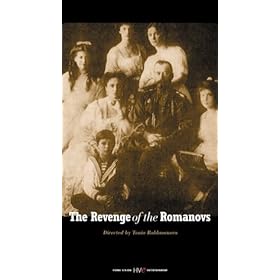
If you're looking for nonfiction material, there unfortunately aren't very many out there. The one I have seen that I enjoy is only available in VHS form, though I very occasionally see it on the History Channel. "The Revenge of the Romanovs" earns points because it includes home movies of the Romanovs themselves (without sound, of course), as well as interviews with the men who found the family's grave outside Ekaterinburg. It also shows scientists analyzing the Romanov bones, as well as the state funeral the family was given in 1998.

I'd love recommendations of other movies or documentaries!

Monday, February 22, 2010

the curious case of princess yurievskaya

I missed the anniversary of the death of Ekaterina Dolgorukova, Princess Yurievskaya, a few days ago. Katya is one of the most interesting members of the Romanov family. She died on February 15, 1922, and was - technically - the Tsaritsa of Russia, if we go by the definition of the tsaritsa being the wife of the Tsar.

Ekaterina was born in 1847, but did not meet the tsar until she was a teenager. Alexander's wife Maria Alexandrovna was a patron of the Smoly Institute, a St. Petersburg school for wealthy girls. As a favor to Maria, Alexander visited the school one day and met Ekaterina. At first he spent afternoons taking the young girl on carriage rides and discussing politics with her, though he certainly wanted her as a mistress. Her own mother and teacher urged her to better her circumstances, but Ekaterina was stubborn. However, she eventually became the tsar's mistress in 1866. She was 18; he was 47.

It was an affair that would last into the end of Alexander's life. Maria was a very sick woman. Tuberculosis and the early deaths of two children, Alexandra and Nicholas, had robbed her of her health. After the birth of her eighth child, doctors advised the tsaritsa not to have any more children. A lack of birth control meant the tsaritsa had to cease having sex with her husband completely - though Alexander had hardly been faithful before.

The tsar eventually moved Ekaterina into the Winter Palace - under the same roof as his wife. The couple would come to have four children together, not a huge surprise, as they documented their desire for each other in thousands of letters, some of which were auctioned a few years ago. Alexander and Ekaterina were very careful within their letters, never signing them and using "bingerle" as a code word for sex. But the tsar did not completely hide his love for this woman. He married Ekaterina morganatically soon after Maria's death, and created the title Princess Yurievskaya for his new wife and children. Ekaterina supposedly had a premonition the day Alexander was assassinated that something terrible was going to happen to him. She and her children with the tsar, three of whom survived infancy, were not allowed to attend the state funeral, and while Katya was given an impressive pension (3.4 million rubles), she continued to be scorned by the Romanovs for the rest of her life.

a note about dates

Important days in Russian history are often written with two different dates. That is because during the time of the Romanovs, the calendar was written in the Julian year, rather than the Gregorian style, which came about later. Most dates have been modified to reflect the new style that we all use today, and I'll continue to use this - but just know that the Romanovs often operated 12 days behind!

the curse of the name alexandra

The name Alexandra pops up infrequently throughout the Romanov family tree, but with it comes misfortune to almost every bearer of that name.

The youngest unfortunate Alexandra was the eldest child of Alexander II and his wife Maria, Alexandra Alexandrovna. Born in 1842, she was a favorite of her father and mother. But Alexandra died at age six of meningitis, leaving her parents devastated.


An even earlier unlucky Alexandra was Alexandra Pavlovna, aunt to Alexander II and daughter of Paul I (Catherine the Great's son). She was first heartbroken over an almost-engagement to the King of Sweden that fell through when he discovered a clause in the marriage contract stating Alexandra would retain her Orthodox faith. She finally married Archduke Joseph of Austria, a union that would prove both short-lived and unhappy. Alexandra Pavlovna died when she was only 17 years old of childbed fever; her baby, a girl named Alexandrine also died.


Alexandra Nicholaevna was a niece to Alexandra Pavlovna and the sister to Alexander II. When she met Prince Frederick "Fritz" of Hesse, a prospective bridegroom for her older sister, Olga, the couple immediately fell in love. They were allowed to marry in 1844, but Alexandra soon became ill with tuberculosis. To make matters worse, she also found out she was pregnant. She eventually went into labor three months premature and gave birth to a son, Wilhelm. Both mother and baby soon died.


Grand Duchess Alexandra Georgievna was actually born a princess of Greece and Denmark, and is a maternal aunt of Prince Philip, Queen Elizabeth II's husband. When Alexandra was 19, she married Grand Duke Paul Alexandrovich, a son of Alexander II. At the end of her second pregnancy, Alexandra was walking with a friend along the Moskva River and jumped from the bank into a boat anchored along the shore. She fell as she landed, and collapsed the next day in tremendous pain. She eventually gave birth to a son, Dmitri Pavlovich, but died soon after. Miraculously, her son, born during the seventh month of pregnancy, survived, thanks to his uncle, Grand Duke Sergei Alexandrovich, the brother of Alexander III. Paul was so grief-stricken, he tried to leap into Alexandra's coffin as it was lowered into the ground. Dmitri and his older sister Maria were raised mostly by their uncle Sergei and his wife Elizabeth Feodorovna (also a sister to the tsaritsa Alexandra), which was a comfort to the couple, who had never been able to have children themselves. Paul eventually remarried morganatically.


Perhaps the only fortunate Alexandra was Alexandra Iosifovna, wife of Konstantin Nicholayevich, brother to Alexander II. She was born Alexandra Friederike Henriette of Saxe-Altenberg. It is said she looked so much like Alexandra Nicholaevna, her husband's late sister, that her mother-in-law burst into tears upon meeting her. She and Konstantin would eventually have six children, but the happiness they had initially started with did not last. While her husband was unfaithful to her (as was so common in those days), she lived to be 80, dying in 1911, truly one of the last of the Old Order.


But it would be the tsaritsa who was the last Alexandra. As each of her daughter's names were announced, many in England wondered why none were named for their mother. Margaret Eagar explained the name was considered unlucky by the family.

And of course we know of the fate of the last Alexandra, sadly another unfortunate story.

Thanks to Wikipedia and "Romanov Autumn" by Charotte Zeepvat for information and photographs of these Alexandras!

Sunday, February 21, 2010

what's a grand duchess anyway?

Nicholas and his children in order of birth, 1910

The daughters of the ruler of All the Russias couldn't be called princesses. There were princesses all over Europe. For those priviledged women who could call the tsar their daddy, the only title that would do was Великая Княжна, "Grand Princess." Today it is most accepted as Grand Duchess. Children of emporers, rather than mere kings and queens, were often called by a loftier title. In Austria the children of the Emporer were archdukes and archduchesses. In Russia, they were grand dukes and grand duchesses, indicating that they were "imperial highnesses," instead of "royal highnesses."

As the family continued to multiply at a very quick rate, Alexander III (Anastasia's grandfather) decided in 1885 that only children and grandchildren of the tsar would be grand dukes and grand duchesses. The remainder were referred to as princesses. Only in Russia would being called a princess be a downgrade.

And despite the grandiose titles, the Romanov children were still commonly referred to by their first names and patronyms, going so far as to rebuke the servants for calling them anything else.