 Today is International Women's Day, and I wanted to introduce the woman who had the biggest influence on Anastasia and her siblings: her mother, Alexandra Feodorovna, who started out life as Alix of Hesse.
Alix of Hesse: a tiny title for a girl who would grow to be one of the most influential women in the world. With the advantage of time, perhaps this is unsurprisng: Alix was a granddaughter of Queen Victoria. She married the man who ruled one-sixth of the globe. But her life started out as anything but promising, as early tragedies marred what could have been a happy childhood.
Alix was born Viktoria Alix Helena Luise Beatrice on June 6, 1872. She was the sixth of seven children to Grand Duke Louis of Hesse and his wife Alice, a princess of England. She shared a first name with her oldest sister, though she was always known as Alix after her mother - though the name was Germanized, as the Hessians apparently had trouble pronouncing Alice's name.
The first sorrow her life happened only a year after she was born, when her older brother Freidrich, known as Frittie, toppled from his mother's bedroom window and fell onto the ground below. The fall might have been survivable, had Frittie not been a hemophiliac.
But the real tragedy that shaped Alix happened when she was six. Diptheria broke out among the family, striking everyone but Alix's sister Elizabeth, who was away from home at the time. Marie, the seventh child, known as May, eventually succumbed to the disease, though her death was kept from the other children. When Alice finally told her only surviving son, Ernie, he burst into tears. Alice kissed her son to comfort him, despite the risk of infection, and eventually came down with diptheria herself. She died on December 14, 1878, on the anniversary of her father Prince Albert's death.
Queen Victoria stepped in after the death of her daughter to personally see to her Hessian grandchildren's upbringing, but Alix was already becoming known for her pensive and serious nature. Victoria nurtured a hope that Alix would marry in England; one of her possible husbands was Albert Victor, heir to the English throne. But it was a meeting in 1884 with the heir to the Russian throne that changed Alix's life forever. While they both fell in love, it would be another five years before they would meet - and another five after that before they were allowed to marry. The wedding almost didn't happen, as Alix wrestled with the requirement to convert to the Russian Orthodox faith. Nicholas's father Alexander III had long opposed the match, but the wedding finally happened just as the tsar's health began to fail. It would be a love match that rivaled that of Alix's grandparents, Victoria and Albert. Alix of Hesse became Tsaritsa Alexandra Feodorovna, and Russia would never be the same.
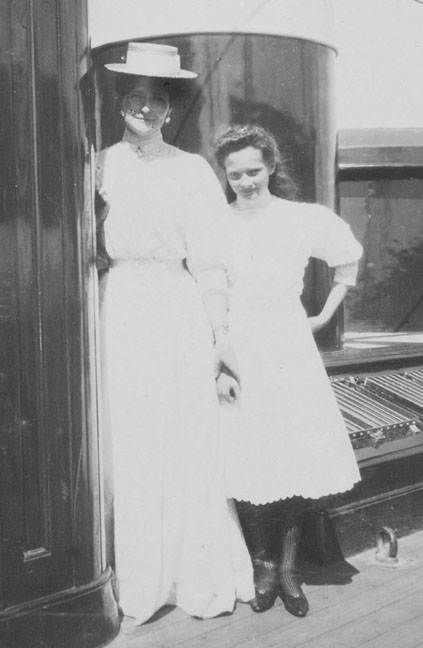 Photo: A rare smile from Alexandra with Tatiana, the daughter she was closest to.
Alexandra was not popular with the Russian people. Unlike her mother-in-law, Marie Feodorovna, Alexandra hated public events. She was shy and preferred to close herself up with her family. While the Romanov family tree was overwhelmingly male for generations, Alexandra produced four girls before the long-sought-after son, Alexei. And to make it worse, Alexei turned out to be a hemophiliac like Alexandra's brother Frittie, a condition that was kept secret from everyone except a select number of friends and servants. The final death noll to Alexandra's image as tsaritsa was her friendship with a peasant turned self-proclaimed holy man, Grigory Rasputin.
Rasputin has been so villanized, it's hard to look at him as anything other than a creepy man who was at least partially responsible for bringing down the Romanov throne (and his pictures don't help his case much). But if you put yourself in Alexandra's shoes, what would you have done differently? Here was a woman under tremendous pressure to produce a son - and when she has a son, he is not the perfect healthy child, but a little boy who falls deathly ill with the smallest bump or cut. Doctors were powerless to heal Alexei, but here was a strange man who helped him. If I were Alexandra, I would have trusted him, too.
When World War I started, life only became more difficult for Alexandra. Her birth country was now the enemy, and her unpopularity did not help her case. The stress of her life, coupled with her son's ill health, meant she often was sick as well, and many pictures exist showing her in a wheelchair. After looking at those photos, it's surprising to me that Alexandra didn't live to see 50 - her face looks much older and wearier. As tragic as her life's end was, it was perhaps how she would have wanted it - together with her family, surrounded by the people she loved most in the world.


